Warning Ignored: Bait-and-Switch Pricing
at Car Dealerships in 2026
of car purchases include the deceptive pricing practice the FTC just warned the auto industry is illegal.
The Problem is Worse Than Anyone Realizes.
In March 2026, the FTC issued a major warning to the auto industry about deceptive pricing practices, including letters threatening enforcement action against 97 dealership groups. This is the strongest federal enforcement signal car dealerships has received in years.
The industry's leading trade group responded by characterizing these practices a niche problem and claimed that the "overwhelming majority" of dealers are compliant.
CoPilot's transaction-level data exposes the reality on the ground floor for consumers.
Discretionary fees added on top of the advertised price. This is the specific practice the FTC flagged in its March 2026 warning.
Based on ~500 real consumer transactions between December 2025 — April 2026.
The gap between what buyers see online and what they actually pay at signing.
Bait-and-switch pricing is not a fringe problem. This is the standard operating procedure for the majority of car dealerships.
Note: This figure excludes paperwork fees (commonly known as doc fees), which are the most pervasive fee type and add more than $500 on average per purchase. Including paperwork fees, the percentage of used car sales with “bait-and-switch pricing” rises to over 4 in 5 deals.
The Issue: Bait-and-Switch Pricing

The traditional car buying process runs on information asymmetry. The dealer knows the real cost of the car, the real margin, and the real value of your trade-in. You don't.
I know this because I spent years building the software that manages that information on the dealer's side — the tools that track inventory, structure deals, and monitor buyer behavior in real time. I watched those tools being used to extract maximum profit from people who had no idea what was happening on the other side of the desk.
Our company, CoPilot, grew out of this simple frustration: Car dealers have a playbook to maximize their profit on every car, but consumers are almost completely unprotected when they walk into a dealership. The industry knows it and actively takes advantage of it.
Dealers made record profits during the COVID-19 pandemic. As the industry suffered from supply chain shortages, vehicle supply became extremely limited on dealer lots and customer demand spiked. For a long time, this gave dealers the upper hand with car shoppers. But now that the market has returned to normal conditions, dealers are struggling to let go of the profits they've become accustomed to. This creates a lot of incentive for “bait-and-switch pricing,” or tacking on undisclosed add-ons at the dealership that jack up the final price of the car.
On March 13, the FTC warned the auto industry (including letters to 97 dealership groups threatening enforcement action) that “bait-and-switch pricing” is a deceptive practice prohibited by federal law. This is a meaningful first step, and it's also been reinforced by state-level action, including a $75 million-plus settlement between the Maryland Attorney General and Lindsay Automotive Group.
The dealer industry's response has frankly left a lot to be desired. Last month, the National Automobile Dealers Association (NADA) hosted a closed FTC compliance webinar with 4,000 dealers. No consumers. No press. No public record. Then they issued this statement:
“No information that leads us to believe this is a bigger problem than the 97 flagged dealers.”
Our data, based on recent used car purchases, show the opposite: Bait-and-switch pricing is a pervasive, industry-wide problem. Our report presents first-of-its-kind transaction-level data on what real buyers are actually paying, focused specifically on the gap between the car's online advertised price and the final price consumers are charged — which is the exact practice the FTC called out. Our data clearly show this problem is far more significant than the industry has acknowledged, and that ordinary consumers bear the cost every day.
What Dealers Added at the Dealership — Beyond the Advertised Price
The following table breaks down common dealer charges at the dealership found in ~500 recent used car purchases. It includes dealer-provided fee descriptions, as well as CoPilot's plain-language description of what the fee actually is. Fees are ranked in descending order by how frequently they appear at the point of sale in used car transactions.
| Type of overcharge | What this actually is | What the dealer calls it | % of used car sales | Avg $ per purchase |
|---|---|---|---|---|
Paperwork fee |
A charge for doing the paperwork that is necessary to sell the car. |
Document (doc) fee, admin fee, processing fee |
94% | $520 |
Digital paperwork fee |
A separate charge for submitting documents electronically (a standard and necessary part of every transaction). |
Electronic filing fee, e-filing fee |
17% | $175 |
Undisclosed add-ons & services |
Upcharges for unnecessary products and services (such as oil change packages or paint protection). |
Protection packages, paint protection, ceramic coating, surface shields, appearance packages |
15% | $1,000 |
Pre-installed anti-theft add-ons |
Pre-installed anti-theft products that appear as an extra line-item charge, sometimes with a recurring monthly fee. Often these are for features the buyer did not request and should have been included in the price of the car. |
Security fee, LoJack, Karr alarm |
10% | $664 |
Other undisclosed pre-installed products |
Add-ons that are already physically installed on the car, then billed as separate line items on the out-the-door price. |
Door edge guards, VIN etching, mudguards, floor mats, nitrogen fill, window tint |
5% | $479 |
“Mandatory” extended warranty purchase |
An optional service contract, misleadingly presented as essential, and often available through third parties at a fraction of the dealership's price. |
Extended warranty, service contracts, powertrain, CPO certification |
5% | $1,480 |
Used car cleaning and repair fee |
Add-on charges for cleaning and preparing the car for sale (normally accounted for in the cost of the car). |
Reconditioning fee |
4% | $1,300 |
What Real Receipts From the Dealership Look Like
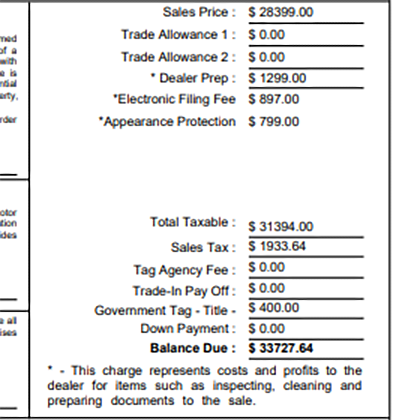
- $1,299 "dealer prep" fee (cleaning & prep, normally factored into price)
- $799 "appearance protection" (extraneous interior/exterior protectant)
- $897 "electronic filing fee" (submitting paperwork online)
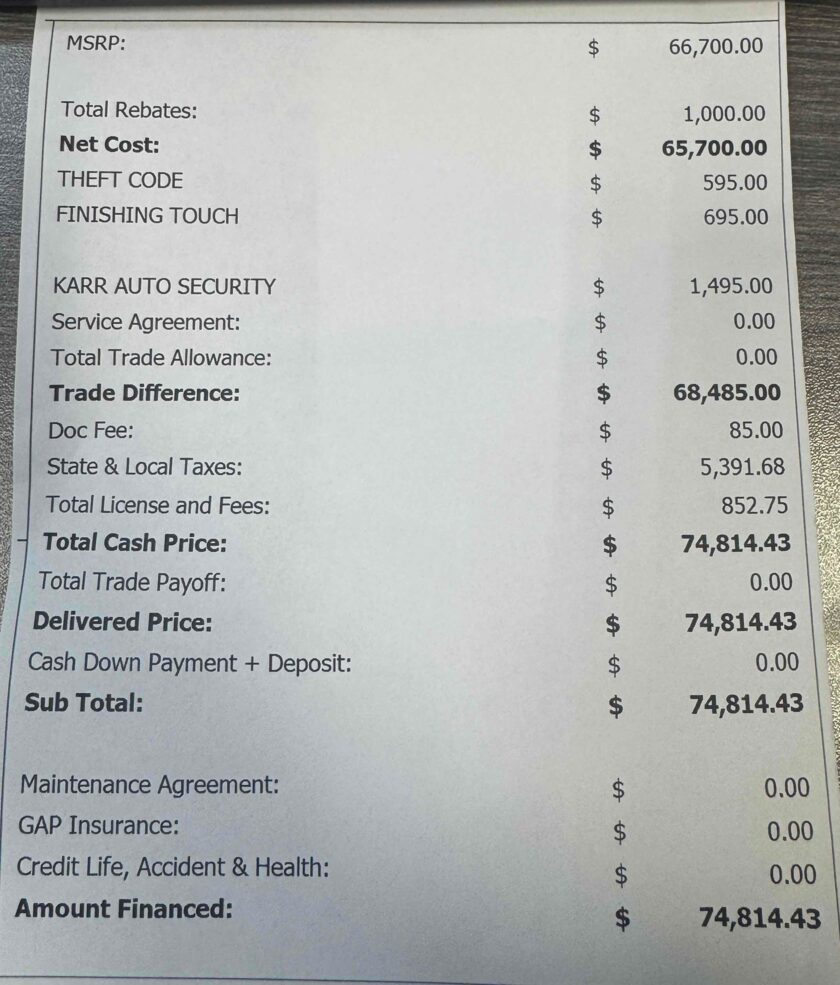
- $1,495 "Karr Auto security" (extraneous GPS tracker; Wrangler comes standard)
- $595 "theft code" (separate pre-installed anti-theft product)
- $695 "finishing touch" (cleaning & prep, typically in cost of car)
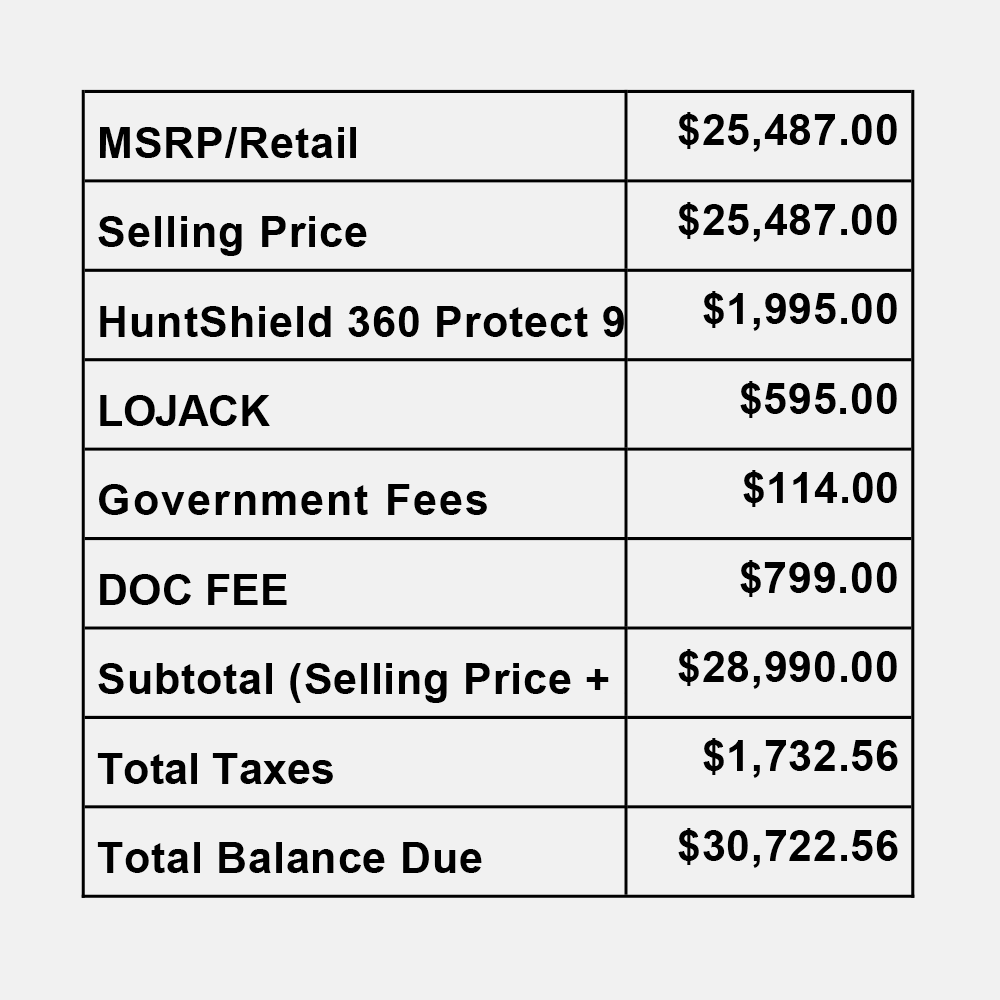
- $799 paperwork ("doc") fee
- $1,995 "Huntshield 360 Protect" (paint & interior protection the buyer didn't ask for)
- $599 "LoJack" (pre-installed anti-theft add-on)
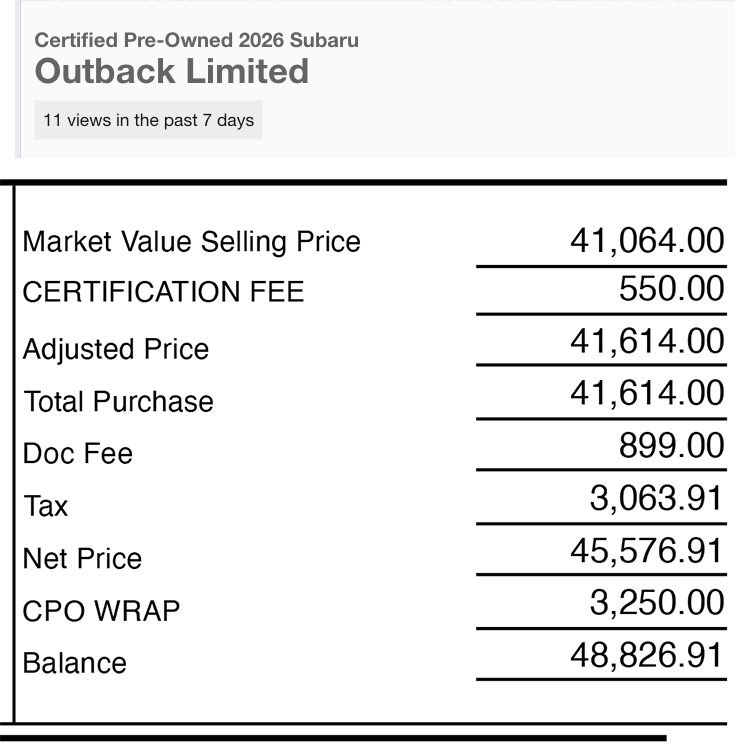
- Vehicle listed as a Certified Pre-Owned (CPO) vehicle
- Buyer then charged a $550 "Certification Fee" as a separate line item
- $899 doc fee on top, plus a $3,250 "CPO Wrap" add-on
Notable Findings
- $1,480Average cost of extended warranties that dealers misleadingly claim are required to purchase the car.
- $1,300Average additional fee charged by the dealer to clean a car before sale.
- $1,000Average total cost of additional undisclosed upcharges for unnecessary products and services.
- 1 in 4Buyers paid over $1,500 in overcharges. Nearly 1 in 8 paid over $2,500 — a figure that exceeds most Americans' emergency savings.
What Buyers Actually Said
CoPilot spoke with car buyers across the country in April 2026, several weeks after the FTC's warning. Their accounts reflect the same patterns documented in our transaction data and show what these numbers mean in practice.
We were told it would be a quick process — we were there for eight hours. It's like they did it to just wear you down.
They have ways of making you feel like you're crazy when you're there.
I left with a way more expensive car than I went in intending to buy.
A consistent theme across interviews: Buyers described the finance office as the most confusing part of the purchase — where previously undisclosed fees are introduced quickly, under time pressure, and after hours of negotiation have worn them down. This maps directly to the fee data: undisclosed add-ons and services ($1,000 on average) and “mandatory” extended warranties ($1,480 on average) are predominantly F&I products.
Nearly every buyer interviewed said they had no idea dealer pricing practices might be violating the law. None had heard of the FTC's March 2026 warning before the interview.
About This Data
This report is based on ~500 real consumer transactions analyzed by CoPilot's platform between December 1, 2025 and April 30, 2026. Transactions were collected from buyers seeking out-the-door price verification prior to or during their vehicle purchase. Each deal includes the advertised price, a full itemized fee breakdown, and the verified final out-the-door total.
Fee categorization: Fees are identified and categorized using the names provided by dealers at the point of transaction. We have also included a plain-language description of what the fee name actually means, in order to offer a clearer picture of the fees that are actually presented to consumers.
What “bait-and-switch” means in this dataset: The 59% figure represents transactions in which buyers paid fees above the advertised price (not including paperwork fees). This is the specific gap the FTC identified as potentially illegal in its March 2026 warning.
About CoPilot
CoPilot is an AI-powered car buying platform built entirely on the consumer's side. Unlike every major car buying tool on the market, CoPilot takes no money from car dealerships — which gives us the freedom to tell consumers the truth about dealer pricing. The CoPilot Clean Price Check tool audits dealer quotes and gives buyers a compliance report they can use in the dealership.
Learn more about our efforts to end bait-and-switch pricing for good at DealershipTricks.